IEEE TVCG · 2026
NRRS: Neural Russian Roulette and Splitting
Peking University
Abstract
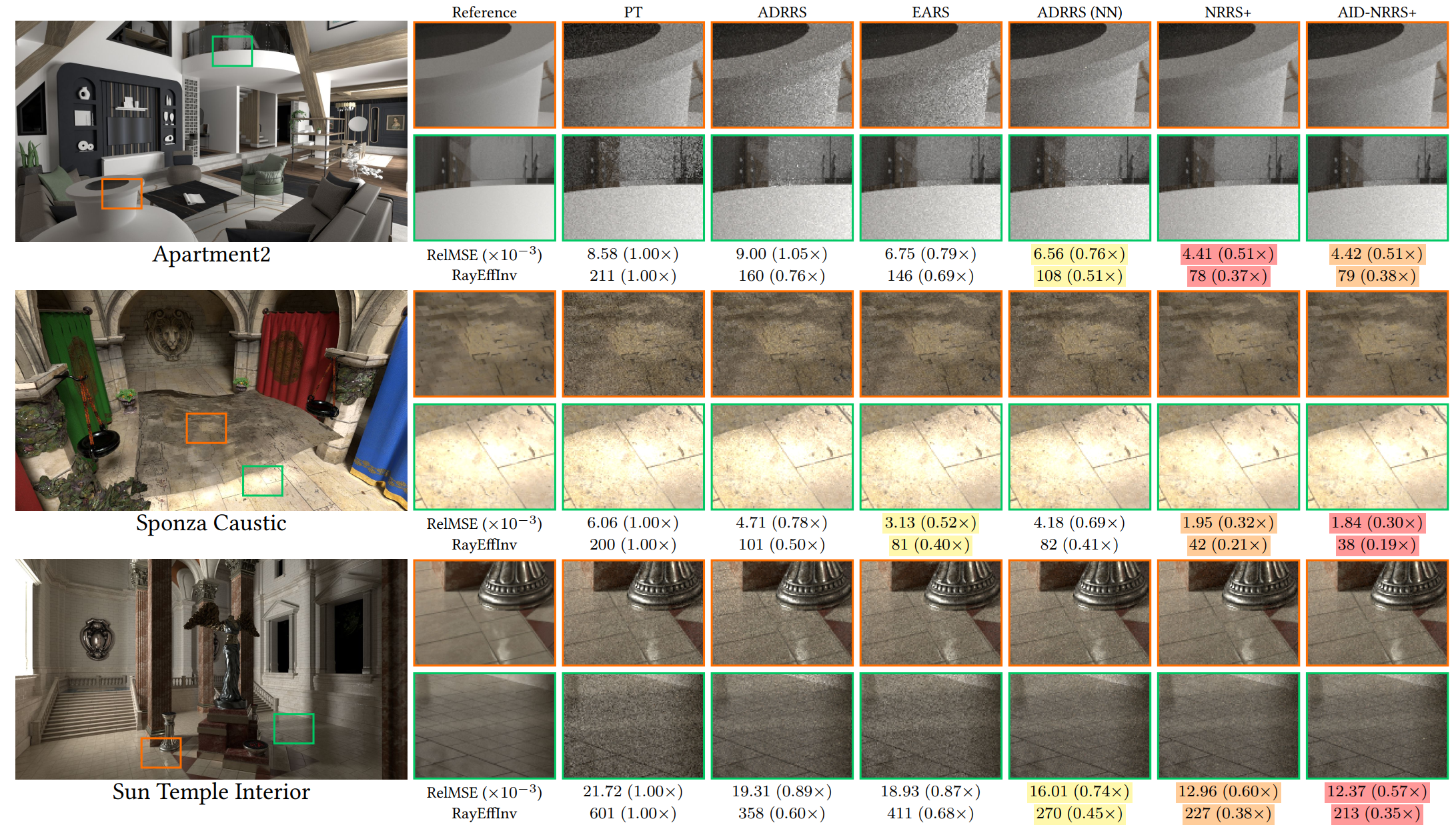
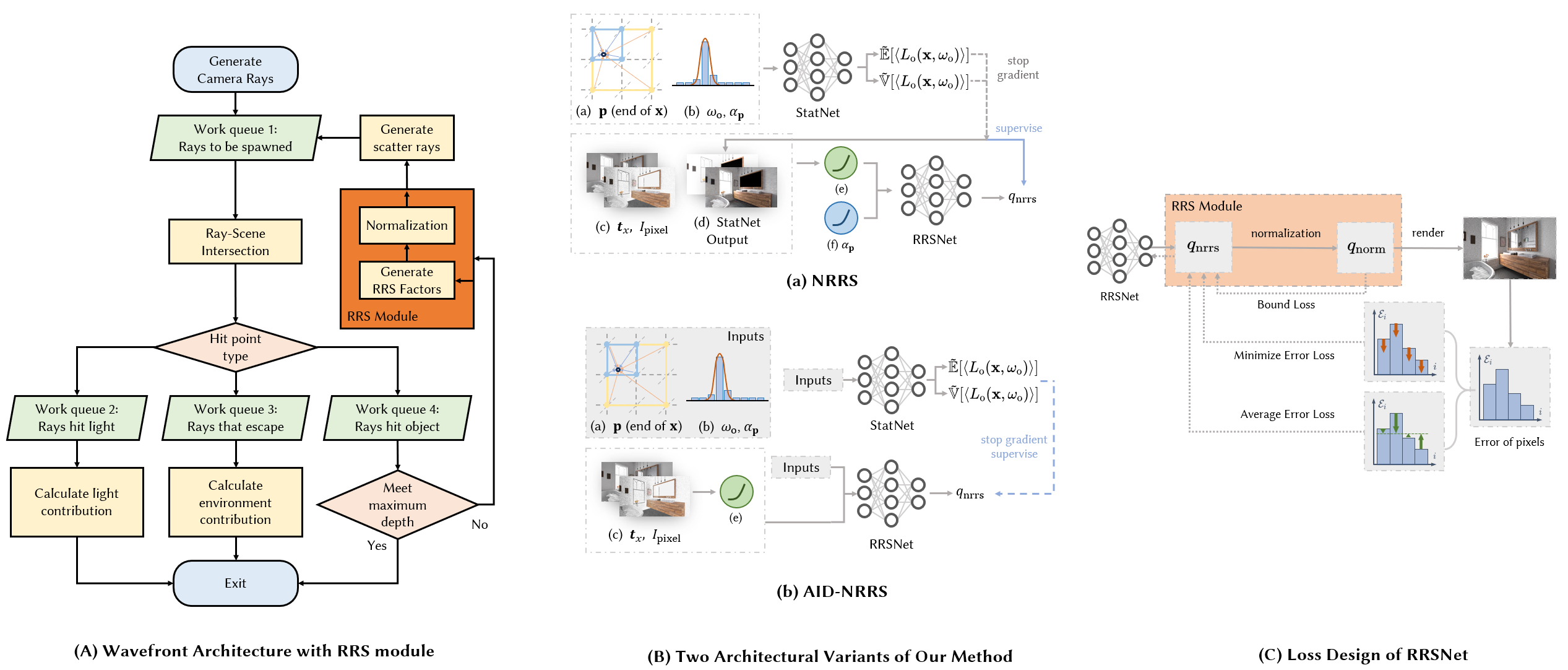
We propose a novel framework for Russian Roulette and Splitting (RRS) tailored to wavefront path tracing, a highly parallel rendering architecture that processes path states in batched, stage-wise execution for efficient GPU utilization. Traditional RRS methods, with unpredictable path counts, are fundamentally incompatible with wavefront's preallocated memory and scheduling requirements. To resolve this, we introduce a normalized RRS formulation with a bounded path count, enabling stable and memory-efficient execution. Furthermore, we pioneer the use of neural networks to learn RRS factors, presenting two models: NRRS and AID-NRRS. Both feature a carefully designed RRSNet that explicitly incorporates RRS normalization. We also introduce Mix-Depth, a path-depth-aware mechanism that adaptively regulates neural evaluation. Extensive experiments demonstrate that our method outperforms traditional heuristics and recent RRS techniques across a variety of complex scenes.
Contributions
- A normalized RRS framework designed for efficient and practical wavefront path tracing.
- NRRS and AID-NRRS, the first neural models for estimating RRS factors with high efficiency.
- Mix-Depth, a general path-depth-aware strategy that combines multiple RRS approaches with minimal overhead.
Method Overview
Citation
@article{jin2026NRRS,
  author   = {Jin, Haojie and Ren, Jierui and Chen, Yisong and Wang, Guoping and Li, Sheng},
  journal  = {IEEE Transactions on Visualization and Computer Graphics},
  title    = {NRRS: Neural Russian Roulette and Splitting},
  year     = {2026},
  volume   = {32},
  number   = {7},
  pages    = {7001-7016},
  keywords = {Global Illumination, Neural Networks, Russian Roulette and Splitting, Wavefront architecture},
  doi      = {10.1109/TVCG.2026.3691565}
}